
Christopher Nolan Movies, The Odyssey, Net Worth, Oscars, CGI and What’s Next
Christopher Nolan is one of the most recognized filmmakers of modern cinema, known for ambitious stories, complex narrative structures, large-format cinematography, practical filmmaking techniques, and movies that often explore time, memory, identity, science, war, and human relationships. His career includes acclaimed films such as Memento, The Dark Knight, Inception, Interstellar, Dunkirk, Tenet, and Oppenheimer. His latest major project, The Odyssey, brings his filmmaking style to one of the most famous stories in ancient literature.
For people searching for Christopher Nolan, the biggest questions often involve his movies, his new film The Odyssey, his net worth, his brother Jonathan Nolan, his use of CGI, his Academy Awards, where he lives, and what he plans to make next.
Who Is Christopher Nolan?
Christopher Edward Nolan was born on July 30, 1970, in London, England. He became interested in filmmaking at a young age and later studied English literature at University College London, where he was also involved with filmmaking activities.
Nolan began his feature-film career on a small scale. His first feature film, Following, was released in 1998, while Memento in 2000 became the project that brought him major international attention.
Memento was particularly important because it introduced audiences to the kind of storytelling that would become closely associated with Nolan. The movie plays with chronology, memory, perspective, and the reliability of what audiences believe they know.
From there, Nolan moved into larger productions, eventually becoming one of Hollywood’s most influential directors. His filmography includes superhero movies, science-fiction adventures, war dramas, psychological thrillers, historical films, and epic mythology.
Christopher Nolan Movies: Complete Feature Film Timeline
People searching for Christopher Nolan movies often want to know how his filmography developed over time. His directing career demonstrates a steady movement from independent filmmaking toward increasingly ambitious international productions.
| Year | Christopher Nolan Film | Main Genre |
|---|---|---|
| 1998 | Following | Crime / Thriller |
| 2000 | Memento | Psychological Thriller |
| 2002 | Insomnia | Crime / Mystery |
| 2005 | Batman Begins | Superhero / Action |
| 2006 | The Prestige | Mystery / Drama |
| 2008 | The Dark Knight | Superhero / Crime |
| 2010 | Inception | Science Fiction / Thriller |
| 2012 | The Dark Knight Rises | Superhero / Action |
| 2014 | Interstellar | Science Fiction / Drama |
| 2017 | Dunkirk | War / Drama |
| 2020 | Tenet | Science Fiction / Action |
| 2023 | Oppenheimer | Historical Drama |
| 2026 | The Odyssey | Epic / Action / Mythology |
This progression shows how Nolan has repeatedly experimented with different genres while maintaining several familiar interests, including time, perception, memory, sacrifice, morality, and the consequences of human decisions.
Why Christopher Nolan Films Are So Different
One of the defining features of Christopher Nolan films is their ability to combine complicated ideas with mainstream entertainment.
Inception turns dreams into a detailed system involving multiple levels of consciousness. Interstellar combines space exploration with questions about time, gravity, survival, and family. Dunkirk uses multiple timelines to create tension, while Tenet makes temporal inversion part of the mechanics of its story.
Nolan also frequently expects viewers to participate in the storytelling.
Instead of explaining every idea immediately, his movies often provide clues through editing, dialogue, sound, visual details, symbolism, repeated imagery, and changes in perspective.
That approach has made many of his movies popular subjects for discussion long after their theatrical releases.
Does Christopher Nolan Use CGI?
One of the most common questions about the director is: does Christopher Nolan use CGI?
Yes, Christopher Nolan does use CGI and digital visual effects. However, he is also well known for using practical filmmaking whenever a physical method can create the result he wants.
This distinction is important because Nolan is sometimes described as a filmmaker who never uses CGI. That description is inaccurate.
His productions may combine physical sets, miniatures, practical effects, real locations, mechanical effects, stunt work, visual-effects compositing, and computer-generated imagery.
For Oppenheimer, Nolan famously pursued a practical approach to depicting the Trinity nuclear test instead of creating that particular explosion entirely through computer-generated imagery. Digital visual effects were still used elsewhere in the movie.
His preference is therefore not simply “practical effects instead of CGI.” A more accurate description is that Nolan often starts with something physical and real whenever it makes sense, while still using digital effects where necessary.
Practical Effects vs CGI
| Filmmaking Method | Nolan’s Approach |
|---|---|
| Practical effects | Frequently used for physical elements and action |
| CGI | Used when digital work is useful or necessary |
| IMAX photography | Frequently used for major theatrical productions |
| Miniatures | Used when physical models can achieve the desired shot |
| Real locations | Commonly incorporated into productions |
| Digital compositing | Used to combine practical and digital elements |
This mix helps explain why many Nolan movies feel physically grounded even when they contain technically complex visual effects.
Christopher Nolan and The Odyssey
The latest major chapter in Nolan’s career is The Odyssey, an adaptation of Homer’s ancient epic.
The film centers on Odysseus and his long journey home to Ithaca following the Trojan War. The story is filled with battles, monsters, gods, dangerous journeys, temptation, loss, survival, and the desire to return home.
Christopher Nolan’s version features Matt Damon as Odysseus, Anne Hathaway as Penelope, and Tom Holland as Telemachus. The large ensemble also includes Zendaya, Robert Pattinson, Lupita Nyong’o, Charlize Theron, and Samantha Morton.
The film represents one of Nolan’s most ambitious changes in subject matter. Rather than focusing on modern crime, superheroes, theoretical science, or twentieth-century history, he is working with ancient mythology and epic literature.
The Odyssey Movie Christopher Nolan: Why It Is Significant
Christopher Nolan’s Odyssey is significant because it combines one of the oldest surviving epic stories with one of contemporary cinema’s most recognizable large-scale directors.
Nolan has repeatedly shown an interest in stories that place ordinary human emotions inside extraordinary situations.
Odysseus is an ideal example of that structure. The character must survive a long series of dangerous encounters while dealing with separation from his family and the war’s consequences.
Those themes clearly connect to ideas Nolan has explored before.
Interstellar deals heavily with separation and the desire to return home. Dunkirk focuses on survival and the experience of people caught in war. Oppenheimer examines the personal consequences of historical events much larger than any individual.
The Odyssey gives Nolan an opportunity to explore similar ideas through an ancient mythological framework.
Christopher Nolan The Odyssey Reviews
Interest in Christopher Nolan Odyssey reviews has been especially high because the movie represents both a major literary adaptation and a large-scale theatrical production.
Reviews have examined different aspects of the film, including its visual scale, interpretation of Homer, performances, action sequences, emotional themes, and relationship with the original story.
Some critics have emphasized Nolan’s ability to create spectacle, while others have focused more heavily on how much the film changes or reinterprets elements of the ancient poem.
This difference in critical interpretation is worth remembering. An adaptation does not have to reproduce every detail of its source material to offer a distinct cinematic interpretation.
Viewers familiar with Homer may approach the movie differently from audiences experiencing the story for the first time.
Christopher Nolan The Odyssey Trailer
The Christopher Nolan The Odyssey trailer generated considerable interest because of the production’s scale and mystery surrounding the project.
The trailer emphasizes epic landscapes, ships, battles, warriors, costumes, dramatic performances, and large-scale environments.
It also reflects Nolan’s preference for presenting major cinematic moments as physical experiences rather than relying entirely on digital environments.
One particularly important aspect is the film’s relationship with IMAX. Nolan has spent much of his career encouraging audiences to experience his work on large-format screens, and The Odyssey continues that philosophy.
Christopher Nolan’s Most Important Movies
Christopher Nolan’s filmography contains several movies that became major reference points in modern filmmaking.
Memento
Memento was the movie that established Nolan as a major new voice in cinema.
The narrative follows Leonard Shelby, a man dealing with severe short-term memory problems while trying to identify the person responsible for a devastating crime.
Its fragmented structure forces viewers to experience confusion alongside the protagonist.
The Dark Knight
The Dark Knight showed how a comic-book adaptation could incorporate elements of crime drama, psychological thriller, moral conflict, and action cinema.
The movie became one of Nolan’s most influential works and helped redefine expectations for superhero filmmaking.
Inception
Inception revolves around the concept of entering people’s dreams and manipulating information within layered dream environments.
Its mixture of action, psychological tension, science-fiction ideas, and complicated chronology became a defining example of Nolan’s style.
Interstellar
Interstellar uses space exploration as the foundation for a story about survival, scientific discovery, time, and family.
The movie combines large-scale cosmic imagery with deeply personal relationships.
Dunkirk
Dunkirk takes a different approach to the traditional war movie.
Instead of following one straightforward timeline, Nolan divides the story across different time periods involving soldiers, civilians, and pilots.
As the timelines eventually come together, the tension created by the editing becomes one of the movie’s most important storytelling tools.
Tenet
Tenet is among Nolan’s most conceptually complicated films.
Its central idea involves the inversion of objects and people moving backward through time. The result is an action movie where chronology itself becomes part of the conflict.
Oppenheimer
Oppenheimer represented another major change for Nolan.
The film tells the story of J. Robert Oppenheimer and the development of the atomic bomb while exploring scientific discovery, political pressure, personal relationships, responsibility, and historical consequences.
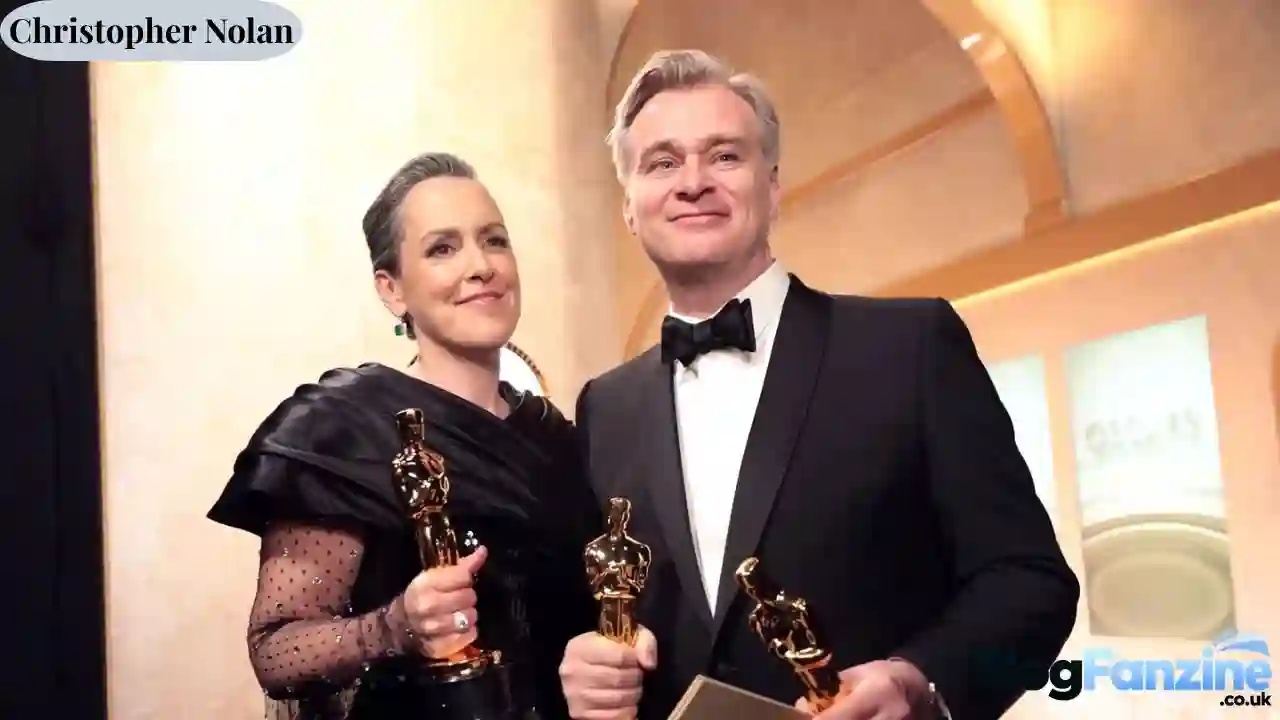
The movie became a major awards success and earned Nolan his first Academy Award for Best Director.
How Many Oscars Does Christopher Nolan Have?
A frequently searched question is how many Oscars does Christopher Nolan have?
Christopher Nolan has personally won two Academy Awards for Oppenheimer.
He won the Oscar for Best Director, while also receiving the Best Picture award as one of the film’s producers.
The movie itself won seven Academy Awards at the 96th Academy Awards.
| Oscar Question | Number |
|---|---|
| Academy Awards personally won by Christopher Nolan | 2 |
| Best Director Oscars | 1 |
| Best Picture Oscar as a producer | 1 |
| Oscars won by Oppenheimer | 7 |
The distinction matters because Nolan’s personal awards total is different from the overall number of awards won by Oppenheimer.
Christopher Nolan Net Worth
Christopher Nolan net worth is another popular search topic.
Online celebrity-finance estimates commonly place his wealth in the hundreds of millions of dollars, with some widely published estimates putting it around $250 million.
It is important to treat this number as an estimate rather than a verified personal financial statement.
Nolan does not publish a complete public breakdown of his private assets, investments, taxes, contracts, property holdings, or annual income.
His financial success has been associated with multiple roles within major film productions. In addition to directing, Nolan has worked as a writer and producer and has developed significant creative influence over the films he makes.
As his movies became major worldwide releases, his negotiating power within the film industry also grew.
Christopher Nolan Brother: Who Is Jonathan Nolan?
The Christopher Nolan brother most people are searching for is Jonathan Nolan.
Jonathan Nolan is a screenwriter, producer, and director who has collaborated with Christopher on several important projects.
Their creative relationship goes back to Memento, which was inspired by Jonathan Nolan’s short story.
Jonathan later worked on scripts connected with The Prestige, The Dark Knight, The Dark Knight Rises, and Interstellar.
He subsequently built his own career in television, including major projects such as Westworld and Fallout.
The brothers have therefore had separate careers while remaining connected through writing, producing, storytelling, and discussions about each other’s projects.
Where Does Christopher Nolan Live?
Searches for where does Christopher Nolan live generally refer to his general residential base rather than a private address.
Public biographical reporting has associated Nolan and his wife, producer Emma Thomas, with Los Angeles.
Because exact residential information is private, a general location is more appropriate than publishing specific property details.
Nolan has strong professional ties to both Britain and the United States, reflecting his British upbringing and long career in Hollywood.
Christopher Nolan Next Movie
Another major search query is Christopher Nolan next movie.
After The Odyssey, Nolan has indicated that he expects a substantial break before starting another movie.
Reports surrounding the film have suggested that he intends to take several years before returning to another major production.
At present, speculation about his next project should be separated from an officially confirmed movie announcement.
Fans regularly speculate about possible science-fiction projects, historical stories, original scripts, adaptations, and other concepts, but rumors should not automatically be treated as confirmed information.
For now, The Odyssey represents the latest major feature in Nolan’s directing career.
What Comes After The Odyssey?
The uncertainty surrounding Nolan’s next project is consistent with the way his career has developed.
He rarely operates on a simple annual-release schedule. His productions often require years of development, extensive location work, large crews, complex visual planning, and specialized cinematography.
A Nolan movie can therefore take several years from the earliest concept to theatrical release.
That long production cycle helps explain why there can be extended periods between his films.
Why Is Christopher Nolan So Interested in Time?
Time may be the most recognizable recurring concept in Nolan’s work.
In Memento, memory disrupts chronological understanding.
In Inception, each dream level operates at a different rate of time.
In Interstellar, relativity creates major differences between characters experiencing time in different environments.
In Dunkirk, three timelines gradually converge.
In Tenet, time becomes an actual mechanical force within the plot.
Rather than simply making movies about clocks or chronology, Nolan repeatedly asks how people behave when their understanding of time changes.
That question can become emotional, psychological, scientific, or philosophical depending on the film.
Christopher Nolan’s Approach to Storytelling
Nolan’s movies often begin with a powerful central concept.
The starting point could be a person unable to trust his own memory, a technology that changes how people experience dreams, a scientific discovery that changes humanity’s understanding of the universe, or a historical event that carries enormous moral consequences.
After establishing that idea, Nolan usually creates a set of internal rules.
Those rules make the world understandable even when the story itself becomes complex.
This is one reason his movies often reward repeat viewing.
A first viewing may focus on suspense and emotion, while a second viewing can reveal clues, connections, structural choices, and details that were difficult to notice initially.
Christopher Nolan and Large-Format Filmmaking
Large-format photography has become an important part of Nolan’s filmmaking identity.
He has consistently supported film photography and has made extensive use of IMAX cameras across his career.
This approach allows major environments, landscapes, faces, architecture, and action sequences to fill the screen with substantial visual detail.
The larger format also reinforces Nolan’s preference for theatrical experiences.
For many viewers, his movies are designed not simply as stories to watch, but as large-scale cinematic events.
Why Nolan Prefers Practical Filmmaking
The attraction of practical filmmaking is partly connected to physical realism.
A real vehicle moving through a real environment behaves differently from a completely computer-generated object.
Actors can also react to physical sets, props, vehicles, costumes, weather, and environments rather than imagining everything through a green screen.
That does not mean practical filmmaking is automatically better than digital effects.
Instead, Nolan’s approach demonstrates that the two methods can work together.
A sequence can begin with a physical environment, use practical effects for the core action, and then receive digital effects during post-production.
This hybrid approach is common in modern major productions.
The Evolution of Christopher Nolan’s Career
Nolan’s career can be understood as a series of expanding creative challenges.
His earliest work demonstrated that ambitious storytelling could be achieved without blockbuster budgets.
Memento’s success gave him access to larger projects.
The Batman trilogy established him as a director who could handle enormous studio productions.
Inception and Interstellar showed that original science-fiction concepts could become major theatrical attractions.
Dunkirk demonstrated how historical filmmaking could be driven by structure and editing.
Tenet pushed his obsession with time into one of his most complicated action formats.
Oppenheimer moved into historical drama and became his biggest awards breakthrough.
The Odyssey expands that progression into mythology and ancient epic storytelling.
Despite the changes in subject matter, several recurring ideas remain.
Recurring Themes in Christopher Nolan Films
Several themes appear repeatedly throughout Nolan’s work.
Time is perhaps the most obvious.
Memory plays a major role in films such as Memento and Inception.
Identity often emerges through characters struggling with perception, responsibility, or transformation.
Sacrifice also appears repeatedly, especially when characters have to choose between personal desires and larger responsibilities.
Home and separation are central to movies such as Interstellar and The Odyssey.
Moral responsibility becomes especially important in The Dark Knight, Oppenheimer, and other films where characters must deal with consequences that extend beyond themselves.
These recurring ideas connect Nolan’s movies even when their settings and genres differ dramatically.
Christopher Nolan Film Style at a Glance
| Feature | Typical Element in Nolan’s Work |
|---|---|
| Narrative | Frequently nonlinear or fragmented |
| Time | Often central to the story |
| Visual style | Large-scale and cinematic |
| Practical effects | Frequently emphasized |
| CGI | Used alongside practical techniques |
| IMAX | Important to major productions |
| Sound | Powerful and immersive |
| Themes | Time, memory, identity, sacrifice, and responsibility |
| Audience experience | Often requires active interpretation |
Why Audiences Continue to Study Christopher Nolan Movies
Nolan’s movies often spark conversation long after their theatrical runs.
People analyze endings, timelines, character motivations, visual symbolism, sound design, scientific concepts, historical accuracy, practical effects, and hidden details.
That ongoing discussion creates a different kind of relationship with the audience.
A movie does not necessarily end when the credits appear. For many viewers, the experience continues through interpretation and discussion.
This is especially visible with films such as Inception, Interstellar, Tenet, Oppenheimer, and now The Odyssey.
Frequently Asked Questions About Christopher Nolan
What is Christopher Nolan famous for?
Christopher Nolan is famous for directing movies such as Memento, The Dark Knight, Inception, Interstellar, Dunkirk, Tenet, Oppenheimer, and The Odyssey. He is especially known for complex narratives, practical filmmaking, large-format cinematography, and stories about time, memory, identity, science, and human sacrifice.
What is Christopher Nolan’s newest movie?
Christopher Nolan’s newest major feature is The Odyssey, an adaptation of Homer’s epic poem centered on Odysseus and his journey home following the Trojan War.
Does Christopher Nolan use CGI?
Yes. Christopher Nolan uses CGI and digital visual effects, but he frequently combines them with practical effects, physical sets, real locations, miniatures, and in-camera techniques.
How many Oscars does Christopher Nolan have?
Christopher Nolan has personally won two Academy Awards for Oppenheimer: Best Director and Best Picture as a producer.
Who is Christopher Nolan’s brother?
Christopher Nolan’s brother is Jonathan Nolan, a screenwriter, producer, and director who collaborated with him on several major films, including Memento, The Prestige, The Dark Knight, The Dark Knight Rises, and Interstellar.
What is Christopher Nolan’s most famous movie?
There is no single objective answer because Nolan’s movies have different audiences and cultural significance. The Dark Knight, Inception, Interstellar, and Oppenheimer are among the films most strongly associated with his mainstream reputation.
Why are Christopher Nolan movies so complicated?
Nolan often builds stories around ideas involving time, memory, perception, parallel structures, or unusual scientific concepts. Instead of explaining every detail immediately, he frequently lets viewers assemble the full picture through the story itself.
Does Christopher Nolan prefer practical effects?
Nolan is well known for favoring practical effects and physical filmmaking where they can produce the result he wants. However, he does not completely avoid CGI and regularly combines practical and digital visual effects.
Final Thoughts on Christopher Nolan
Christopher Nolan has developed one of the most recognizable filmmaking styles in contemporary cinema.
From the small-scale mystery of Following to the fragmented storytelling of Memento, the blockbuster scale of The Dark Knight, the dream architecture of Inception, the scientific drama of Interstellar, the historical intensity of Dunkirk and Oppenheimer, and the mythology of The Odyssey, his career has continued to evolve without abandoning its central interests.
His films repeatedly ask audiences to think about time, memory, identity, responsibility, sacrifice, and the consequences of human choices.
With The Odyssey representing his latest major cinematic project and his next film still not firmly established publicly, Christopher Nolan’s future remains an open chapter. For movie fans, his existing filmography already provides a deep catalog of films to watch, revisit, analyze, and discuss.